Landing Retail and Corporate Roles at Nike starts long before a recruiter views a resume. Candidates move through an online application, psychometric assessments, and several interview rounds that filter thousands of applicants across stores and headquarters.
Nike’s mission to champion continual progress for athletes and sport means hiring teams look for people who fit the culture as much as the skills.



This guide walks through each stage so applications for Nike retail store jobs or Nike corporate careers feel structured rather than overwhelming.
How Nike Hires For Retail and Corporate Teams
Nike operates in more than 190 countries and reported approximately 79,400 employees worldwide in 2024, across stores, distribution, and corporate hubs.
Roles range from store associate, visual merchandiser, and inventory planner through finance analyst, product manager, UX designer, and cybersecurity specialist.
Retail candidates usually focus on:
- customer service,
- product knowledge, and
- sales skills,
While corporate applicants need functional expertise, plus comfort working in cross-functional teams. Hiring teams assess alignment to Nike values such as creativity, courage, teamwork, social impact, sustainability, and diversity alongside technical skills.
Retail and Corporate Roles at Nike both sit inside that same athlete-focused culture, even when one role handles merchandise on the floor and another builds digital tools behind the scenes.
Research Nike and Match Your Profile
Strong applications start with targeted research rather than mass submissions. Official channels such as Nike’s website and LinkedIn feed show current initiatives in sustainability, digital innovation, and athlete partnerships, which help candidates speak in concrete examples.
Time spent studying Nike brands like Jordan and Converse, key product lines such as Air Max or Nike Pro, and recent campaigns pays off during interviews.
That research then feeds into a clear role choice: customer-facing Nike retail store jobs, operations and logistics, data and engineering, or creative functions like design and marketing. Once a focus area feels right, tailoring every document and answer to that direction becomes much easier.
Complete The Nike Online Application
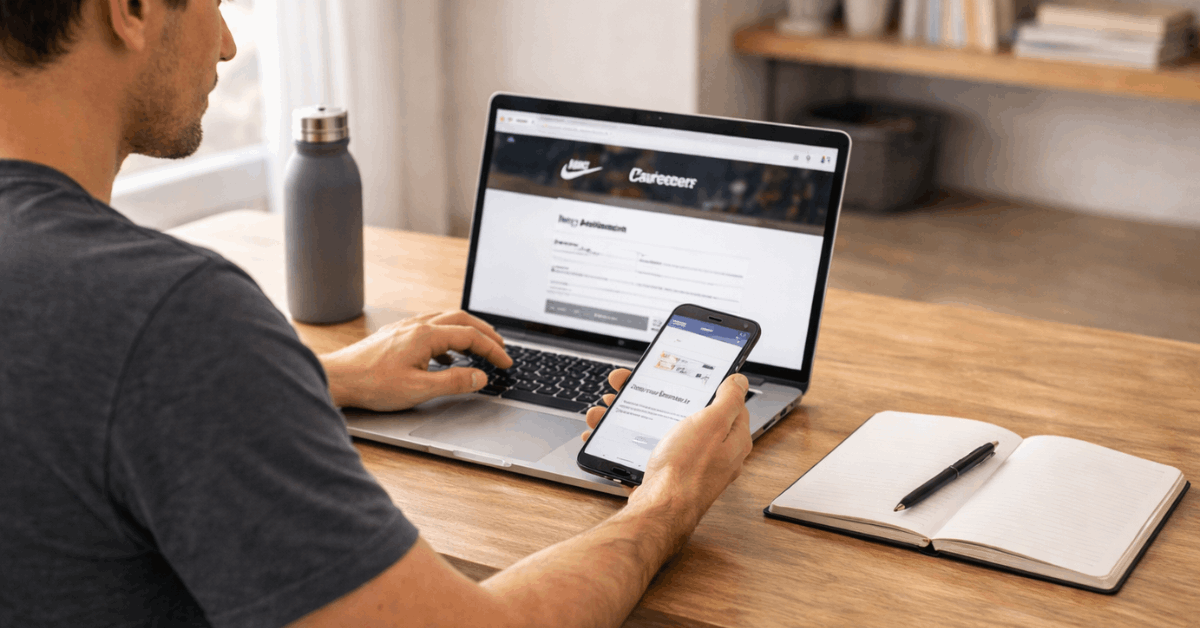
Applications for most roles run through the Nike online application portal on the careers site. Candidates submit contact details, work-eligibility information, visa sponsorship status, notice period, education, and work history, either via manual entry or by importing a resume or LinkedIn profile.
Screening questions may ask about past experience with Nike or affiliates, years in similar product or brand environments, and future sponsorship needs.
Clear, precise responses matter because hiring systems and recruiters often use those fields to filter large volumes quickly. Treat each field as a small pitch:
- concise,
- honest, and
- aligned with the responsibilities and location of the specific opening, rather than a generic description.
Build A Resume That Fits Nike’s Expectations
Sections focusing on resumes benefit from a short, practical framework instead of long theory. Recruiters care about clarity, relevance, and evidence of values more than clever formatting.
The following priorities help a resume survive automated screening and human review for both store and head-office paths.
- Reflect the job description closely, mirroring key skills, tools, and responsibilities so the document passes basic Nike assessment process screens and still reads naturally to humans.
- Demonstrate Nike’s values by highlighting teamwork, innovation, inclusion, integrity, and an athlete mindset through concrete achievements, such as leading a project or contributing to a community initiative.
- Keep the layout clean and modern, using clear headings, readable fonts, and enough white space while avoiding complex graphics that confuse applicant tracking systems.
- Tailor the resume for each role, foregrounding customer-experience metrics for retail roles and tools like Python, Tableau, or Figma for digital and product roles.
- Open with a short summary that links core skills to Nike’s mission and states the target role clearly, rather than vague statements about being “hard-working” or “passionate.”
- Careful proofreading using both manual review and grammar tools reduces basic errors that still cause rejections at scale.
Prepare For Psychometric and Game-Based Assessments
After a resume passes initial screening, many candidates take online assessments from providers such as HireVue and AON Cut-E.
These assessments often combine a Nike personality questionnaire, sometimes branded as a Nike Retail skills assessment, and game-based tasks that measure problem-solving, working memory, adaptability, and numerical reasoning.
Personality blocks usually present sets of statements where responses indicate typical behaviour at work across themes like collaboration, integrity, and drive. Game tasks might involve pattern recognition, risk decisions, or attention tests in short three-minute bursts.
Using Mock Personality Tests
Practice matters because large proportions of candidates are filtered at this stage before any human interview occurs. Mock personality tests help candidates grow familiar with rating scales and question styles without over-engineering answers.
Game-style practice platforms can sharpen reaction time and focus, particularly when assessments must be completed in roughly twenty to thirty minutes.
Honest, consistent responses that match real working style tend to perform better than attempts to “guess” an ideal Nike profile.
Perform Strongly In Nike Interviews
Interview stages typically include at least one digital round plus a final set of conversations that explore behaviour, motivation, and technical depth. For many roles, an asynchronous video interview asks five to eight questions, with limited time to prepare and respond on camera.
Behavioural answers usually work best when structured using the STAR plus Reflection format:
- Situation,
- Task,
- Action,
- Result, then a short learning takeaway.
Candidates aiming at customer-facing roles can expect scenarios around difficult customers, sales goals, or teamwork inside busy store shifts, while corporate applicants see more project, stakeholder, and ambiguity themes.
Nike Video Interview
Nike video interview tips often emphasise environment, energy, and authenticity. A quiet, well-lit space, tested equipment, and a stable internet connection remove basic distractions. Practising answers on camera reduces filler words and helps body language feel natural rather than stiff.
For final-round panels or group interviews, preparation shifts toward deeper knowledge of Nike’s mission, current business context, and cross-functional collaboration stories.
Having several examples ready for the Nike final interview questions allows recruiters to see consistent patterns across different situations rather than one polished anecdote.
Use Nike Internships and Early Careers as a Launchpad
Students and recent graduates often enter through Nike internship programs, which include summer internships of roughly 8–13 weeks and longer placement schemes around twelve months in length.
These roles appear in technology, finance, digital, supply chain, merchandising, design, analytics, HR, and other functions across locations such as the Oregon headquarters and European hubs like Hilversum.
Early-career internships blend project work with mentorship so participants gain real deliverables and exposure to Nike culture.
Eligibility
Eligibility usually requires active enrolment in a university program, matching graduation dates, and any regional legal requirements, for example, specific citizenship rules in parts of Europe.
Candidates who treat these internships as full professional roles rather than “student side projects” tend to stand out for later conversion. Strong performance, proactive networking, and thoughtful questions to managers increase visibility when full-time hiring headcount is tight.
Final Checklist For Retail and Corporate Roles at Nike
Securing interviews for Retail and Corporate Roles at Nike becomes more likely when each step is treated as part of a single narrative.
Early-career paths through internships offer additional entry points when direct hiring feels competitive, while strong portfolios and networking help creative candidates surface for specialist roles.
Consistent effort across these areas sends a clear signal that the applicant genuinely wants to contribute to Nike’s long-term goals around innovation, athlete progress, and sustainable growth.